
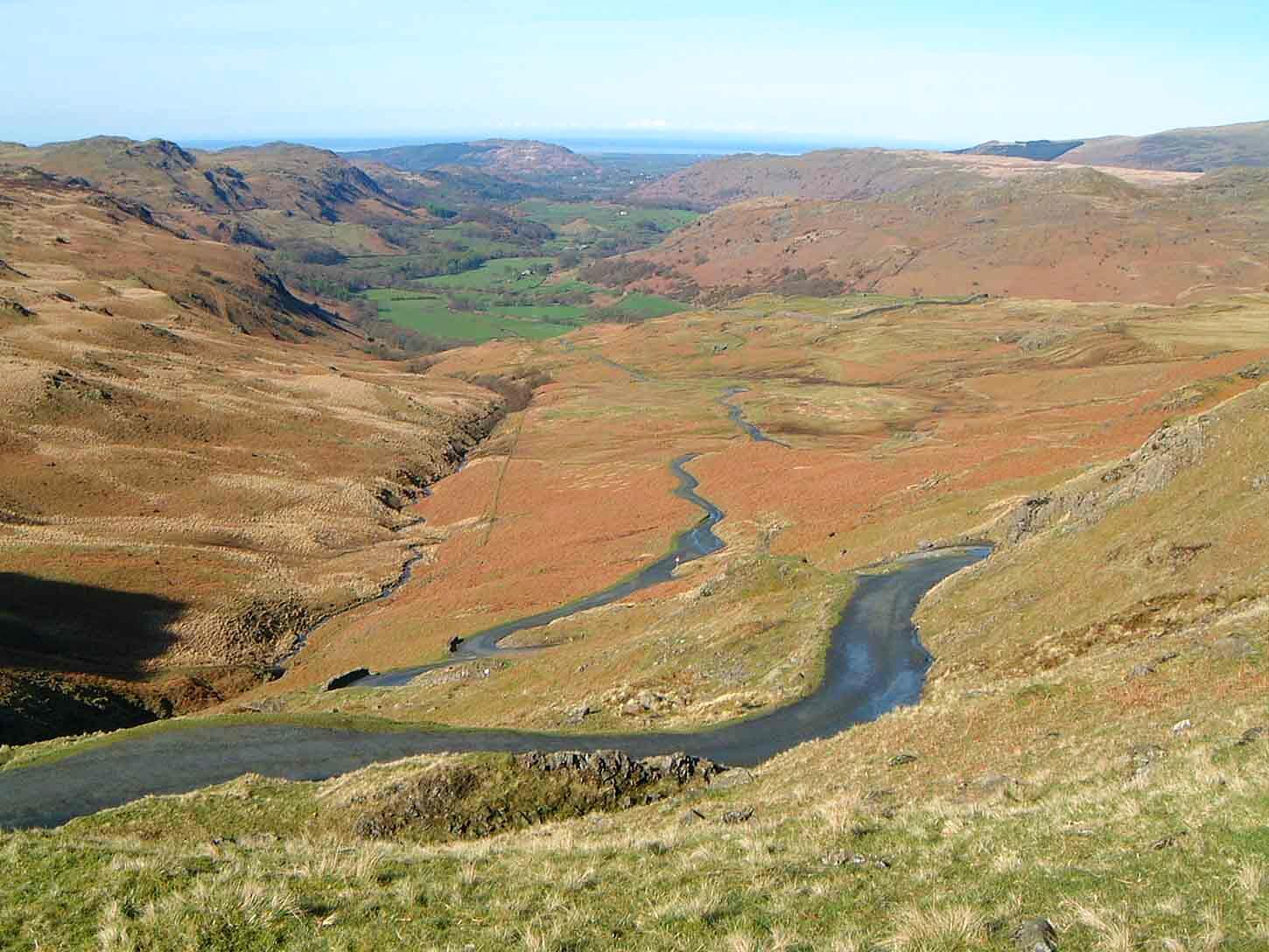
The sign at the foot says it plainly enough. Beyond it the road leaves the green floor of Eskdale and simply goes up, a strip of single-track tarmac laid over the fellside in a series of hairpins so steep that from the driver's seat the windscreen fills with sky and the road vanishes beneath the bonnet. This is Hardknott Pass, and at its steepest it climbs at 1 in 3. It shares the title of England's steepest road with Rosedale Chimney Bank in North Yorkshire, and no one who has driven it would wish to argue the point.
Hardknott does not come alone. To the east, across the head of the Duddon valley, its partner Wrynose climbs to the old meeting point of three counties before dropping into Little Langdale. Together they make the most direct road from the middle of the Lake District to West Cumbria, and the most demanding. This is a road to drive slowly, thoughtfully and in the right conditions, and it is worth every minute.
Where Hardknott Pass is
The road runs west from Little Langdale, near Ambleside, over Wrynose Pass, down into Wrynose Bottom where the young River Duddon begins, past the National Trust's farm at Cockley Beck, and then over Hardknott Pass and down into Eskdale. Both summits stand a little under 400 metres. In miles it is short. In time and concentration it is not.
Hardknott takes its name from the fell beside it, from the Old Norse for a hard, craggy hill. Wrynose is gentler, with gradients of up to 1 in 4, though gentle is a relative word in this company.
A road older than England
The Romans came this way first. They built a road over the pass to link their harbour fort at Ravenglass with the garrisons at Ambleside and beyond, and early in the reign of Hadrian they built a fort on a shelf of the fellside above Eskdale. They called it Mediobogdum. Its garrison was the Fourth Cohort of Dalmatians, auxiliary soldiers from what is now Croatia, perhaps 500 men posted to one of the bleakest stations in the empire. The walls still stand up to two metres high in places, partly rebuilt in the 1950s, with a bath house below and a parade ground levelled out of the mountainside. The pottery suggests they held it for barely twenty years. Stand at the gate and look down the valley towards the sea, and you understand both why they came and why they left.
After the Romans the road became a packhorse route, then a coach road, which the Cyclists' Touring Club's guide of 1911 described as "difficult going West, cruel coming East". The first motor vehicles crossed in 1913. During the Second World War the War Office used the passes for tank training, and the tanks destroyed what surface there was. Only after the war was the road repaired and tarmacked, and only then did Ambleside and Eskdale have a direct motor road between them.
The Three Shire Stone
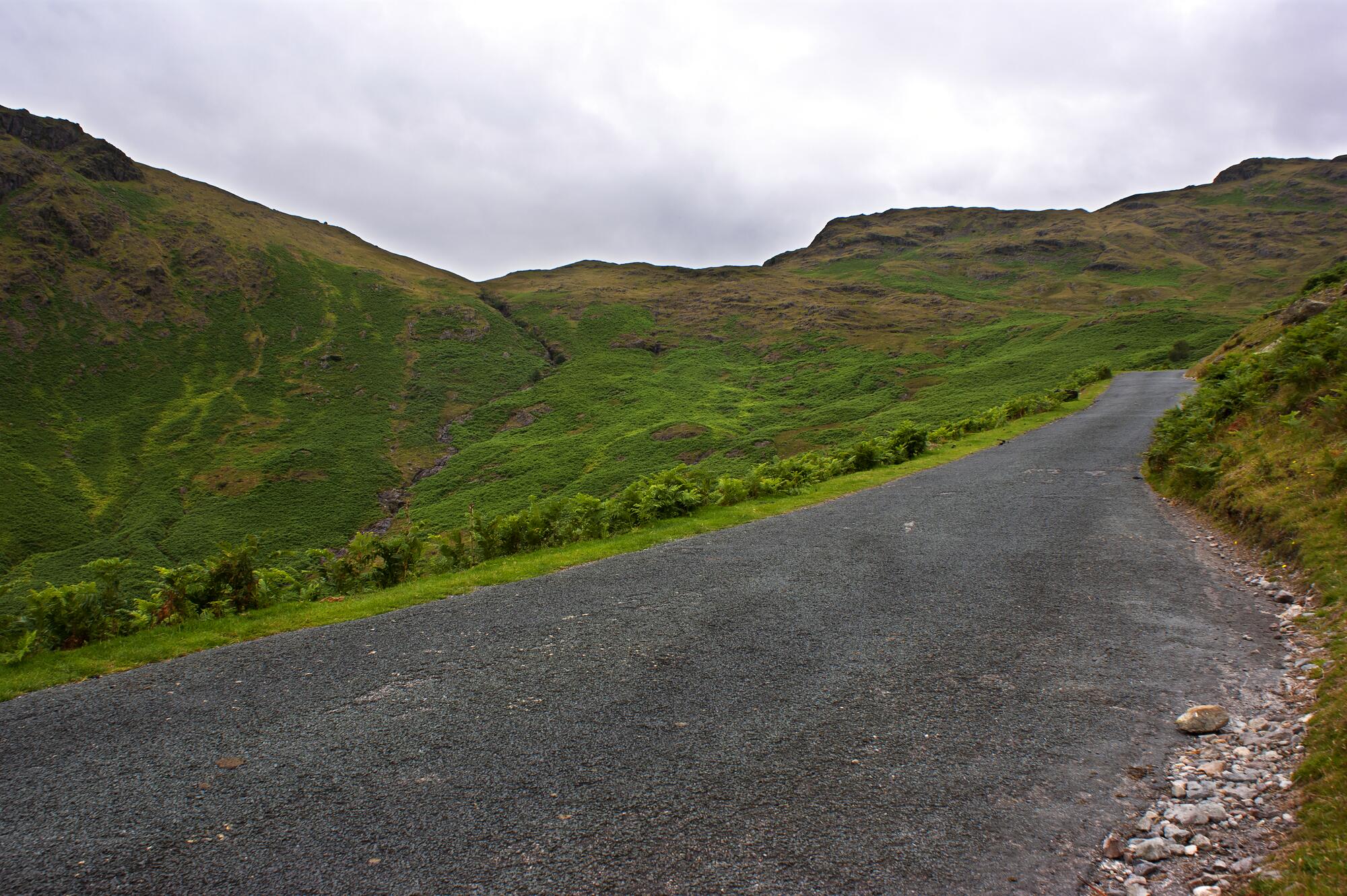
At the top of Wrynose, beside the road, stands a slim stone pillar marking the point where Cumberland, Westmorland and Lancashire once met. It reads "Lancashire" on its face and "W.F. 1816" on its back. It was carved in 1816 but not put in place until around 1860, and it has been knocked down and restored more than once since, which, given the road beside it, is not hard to imagine. Pull in, take the photograph, and look back down to Little Langdale. Below you on that side, at the foot of the pass, Fell Foot Farm is a seventeenth century farmhouse, listed and in the care of the National Trust.
Which way to drive it
The 1911 guide had it right. East to west, from Little Langdale towards Eskdale, is the kinder way. You climb Wrynose, run down the length of Wrynose Bottom beside the Duddon, climb the eastern side of Hardknott and then descend its western hairpins with Eskdale opening ahead of you and the Roman fort on its spur above the valley. Coming east, you climb those same western pitches from a standstill at the foot, which is a harder thing to ask of a clutch.
Whichever way you go, the courtesy on a steep single-track road is to give way to the car coming uphill. A driver who has stopped on 1 in 3 will be grateful not to have to restart.
When to go, and when not to
Early mornings in late spring and early autumn, in dry weather. That is the honest answer. By the middle of a summer's day the passes fill with cars, campervans and cyclists, and the passing places are in constant use. Rain makes the surface slippery, and the broken, patched tarmac is no friend to a car on cold tyres. In winter Hardknott is often closed by ice, and Wrynose too: early in 2026 the council shut it after icy weather. Mountain rescue teams make the point that the lack of a closure sign is no guarantee that the road is passable. If the forecast is doubtful, go another day.
What a low supercar should consider
It is the question every owner of a low car asks, and the answer depends on the car. A narrow, light car with decent ground clearance is ideal. A wide, low supercar can make the crossing, but it asks real thought.
- Width matters more than power. The road is single track with passing places, and meeting a car on a hairpin may mean reversing uphill to the last one. Fold the mirrors where walls close in.
- The inside of each hairpin is the steepest part. Take the wider line where the road allows, and use a nose lift, if fitted, before every tight bend and every crest.
- On the climbs, a dual-clutch gearbox or a heavy clutch will be working hard at walking pace. Keep stops to a minimum and let the gearbox cool if it complains.
- On the descents, use a low gear and let the engine hold the car. Brakes worked hard on a 1 in 3 heat quickly.
- Rear-wheel drive on a wet 1 in 3 with cold tyres is a poor combination. This is a dry weather road.
None of it is a reason not to go. It is a reason to go at seven in the morning, on a dry day, slowly.
Where to stop and stay
At the Eskdale end, Boot is a small village with the Brook House Inn, a proper Lakeland pub with rooms, real ales and a serious collection of malt whisky. The little steam railway from Ravenglass ends nearby at Dalegarth, and the walk up to the Roman fort is a short one from the road.
At the Little Langdale end, the Three Shires Inn shares its name with the stone up the hill. It has ten bedrooms and looks out towards Wetherlam and the Tilberthwaite fells, and a night there puts you at the foot of Wrynose for the first light of the morning, with the road almost certainly your own.
The Lakes with the club
The club's Lakes Secret Escape, three nights in the Lake District this December, is sold out. Members can register their interest in the next one in the members' area, at https://valenzaprive.com/members, and hear first when it opens.
Wherever the club goes, the pace is the road's own: brisk where it invites it, gentle where it does not, and always within the law. These passes belong to the farms and the fellside long before they belong to any car. Membership begins with an application, read personally by the team, at https://valenzaprive.com/membership. If Hardknott and Wrynose are roads you have long meant to drive, we would be glad to hear from you.
Photographs: Mick Knapton, CC BY-SA 3.0; Ian Greig, CC BY-SA 2.0. Colours graded by the club.