
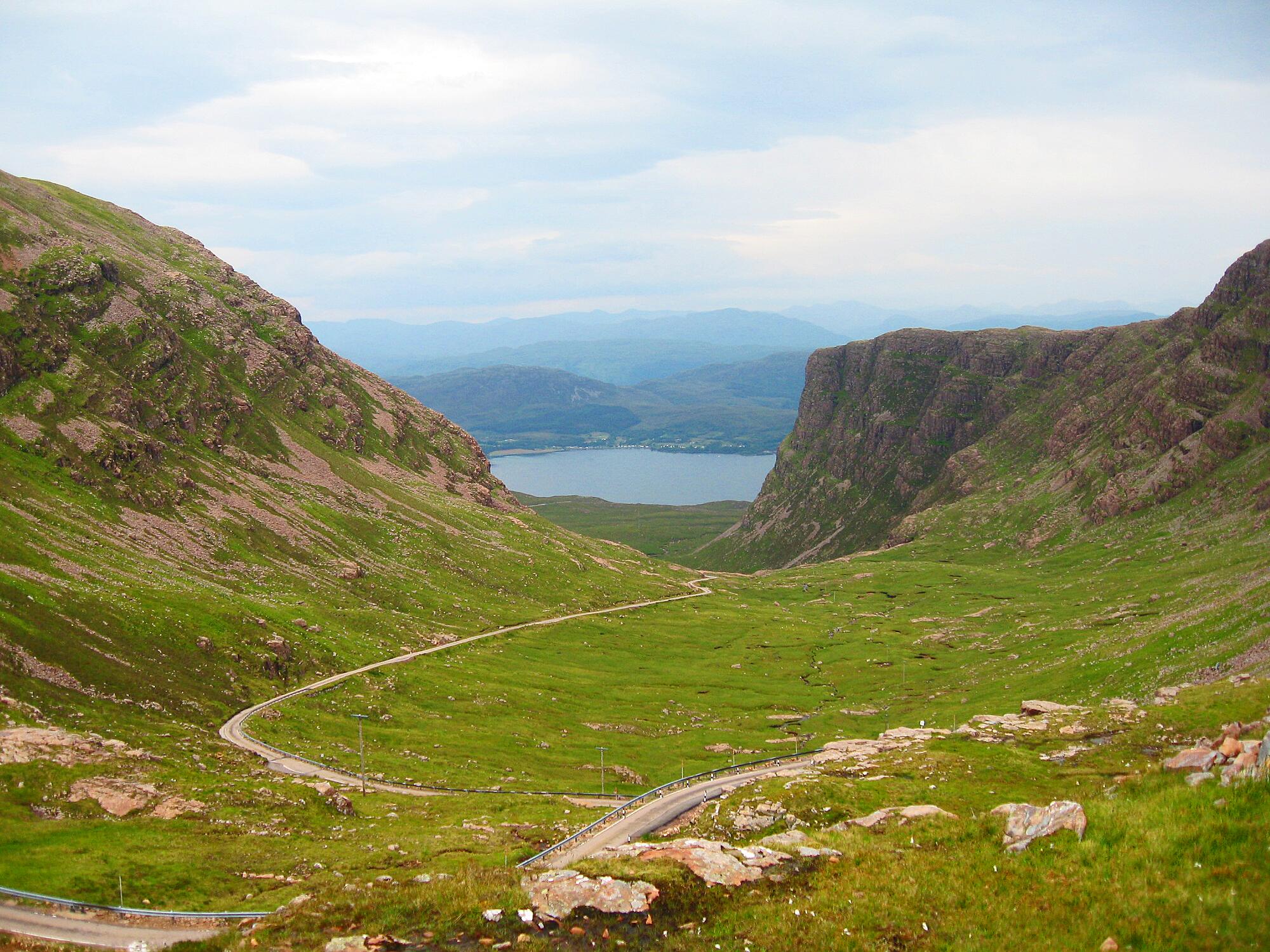
At Tornapress, where the Bealach na Bà begins, the road is barely above the tide. There is a bridge, a junction at the head of Loch Kishorn, and a road sign that has been photographed more often than most mountains: gradients of one in five, hairpin bends, and a road not advised for learner drivers, very large vehicles or caravans after the first mile. Beyond it a single strip of tarmac sets off up the glen and, a few miles on, climbs straight up the head of the corrie in a set of hairpins that look, from below, as if they cannot possibly carry a car.
They can, and have done since 1822. Its name means the pass of the cattle. It crosses the mountains of the Applecross peninsula in Wester Ross, and it is the closest thing Britain has to an Alpine pass. No other road climb in the United Kingdom gains as much height, and few roads anywhere end so well.
Where the Bealach na Bà is
The pass links Tornapress, on the A896 north of Kishorn, with the village of Applecross on the west coast of the peninsula, looking across the Inner Sound to Raasay and Skye. From sea level the road climbs to 626 metres, the third highest road pass in Scotland, with gradients approaching twenty per cent. It is single track throughout, with passing places, and for long stretches there is no wall or barrier at the edge.
The name is a working one. This was a drovers' road, the way cattle were walked out of Applecross towards the great markets in the south. A road was built over the pass between 1818 and 1822, and it was gravel until the 1950s, when it was surfaced and the hairpins widened. Until the 1970s it was the only road into Applecross at all.
Which way to drive it
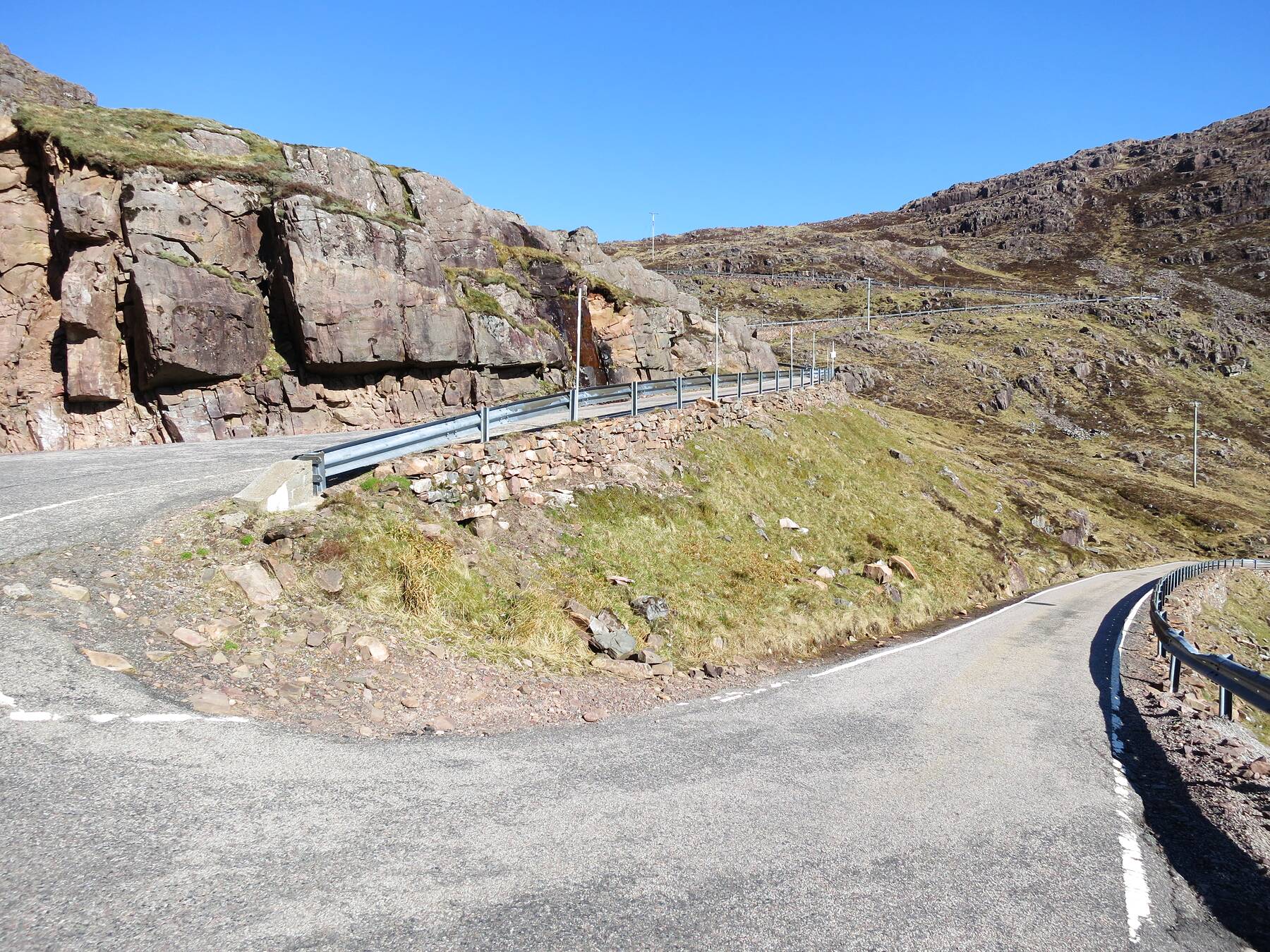
East to west, up from Tornapress. The climb from Loch Kishorn is the drama of the road: a long, steady pull up the glen, a steep kilometre beneath the crags, and then the hairpins themselves, stacked up the headwall of the corrie with nothing but rock and scree on either side. Driving up, you see each bend coming and the car is under load, which is how a steep hairpin is best taken.
At the top there is a car park and, on a clear day, one of the great views in Britain: west over the bare plateau to Raasay, Skye and the Cuillin, and on the very best days the islands beyond. Then the road drops gently, almost lazily, across open moorland to the sea. Coming the other way you would meet the hairpins on the way down, at one in five, on single track, and everything coming up would have the right of way you most want.
Single track and passing places
Most drivers who find the Bealach difficult find the passing places difficult, not the gradient. Using them well is the whole art of Highland driving, and it is simple once the habits are set.
- Read the road a long way ahead. On open hillside you can often see an oncoming car a mile off. Decide early which passing place you will use, and get there.
- If the passing place is on your left, pull into it. If it is on your right, stop opposite it on your own side and let the other car use it. Never cross over into a passing place on the right.
- Give way to traffic coming uphill whenever you can. A car pulling away on a twenty per cent slope is working much harder than one rolling down it.
- If you meet someone between passing places, whoever is nearer one reverses to it, and on a steep slope it is usually kinder for the car going downhill to do so. Do it slowly, and without fuss.
- Passing places are also for letting faster traffic past. If someone has been in your mirror for more than a bend or two, pull in and wave them through: a local with a day's work to do is not touring.
- Never park in a passing place, not even for one photograph. Use the car parks at the summit and the lay-bys where they are marked.
- Raise a hand to say thank you. Everyone does, and it is noticed when you do not.
What to know about the car
The Bealach rewards a car that is small, light and easy to place, and forgives most others if they are driven with patience. A few points matter.
- On the hairpins, take the widest line the road allows and only when you can see the road is clear. On the steepest bends the inside line is far steeper than the outside, and a long car with a low nose will notice.
- The edges of the passing places can be broken and soft, with a drop from the tarmac. Pull in squarely and slowly, and keep a low splitter well clear of the verge.
- Come down in a low gear and let the engine hold the car. The descent to Tornapress is long and steep, and brakes that are leaned on all the way will fade.
- There is no fuel on the pass. Fill up before you leave the A896 and do not arrive in Applecross on the reserve light.
- Sheep, deer and Highland cattle use the road as their own. In the autumn the deer come down at dusk; drive the last miles of the day accordingly.
Weather on the Bealach
The weather here comes in from the Atlantic and arrives without warning. The summit can sit in thick cloud while Applecross is in sunshine, and a clear morning can close in within half an hour. In cloud, slow right down, put the lights on and use the passing places all the more carefully, because the oncoming driver cannot see you either.
There is no fixed winter closure, but the road is often impassable in snow and ice, and the sign at the foot says as much. In the autumn, which is when it is at its best, expect frost on the high ground early in the day. If the summit is white, or the wind is strong enough to rock a parked car, take the coast road instead.
The Applecross Inn, and lunch by the sea
Applecross is a scatter of houses along a bay, and the Applecross Inn on Shore Street is the reason many people come. It is a pub with rooms on the shore, facing the Inner Sound, and its seafood, much of it local, is the thing to order. In summer it fills quickly, so arrive early or book. In the grounds of Applecross House, the Walled Garden runs a café and restaurant, with most of its vegetables grown within its own walls, and it is the quieter choice for lunch.
The coast road round
For the gentler way back, or for a passenger who has seen enough of the hairpins, take the coast road north from Applecross. Completed in the 1970s, it runs round the peninsula by Kenmore and on to Shieldaig on Loch Torridon. It is still single track, still with passing places, but it rises and falls with the shore rather than the mountain, and on a fine evening the views across to Skye and Raasay are as good as anything on the pass. It is longer, and slower, and nobody ever minds.
Where to stay
Rooms at the Applecross Inn are few and book early. Round the coast road, at the head of Loch Torridon, The Torridon is a Victorian shooting lodge turned country house hotel, and makes a fine base for both roads.
The Bealach na Bà with the club
The club's Tartan Run crosses Scotland from coast to coast in five days in the autumn, when the hills are turning and the summer traffic has gone home. From Edinburgh the route goes over the Cairnwell and the Lecht to Loch Ness, then west across the Highlands to the Bealach na Bà above Applecross, and home through Glen Coe. The roadbook marks the stretches to take gently, and the Bealach above all.
The route is driven in full, in season, before a member sees it, and the pace is the road's: brisk where it invites it, gentle where it does not, and always within the law. The tour is set out at https://valenzaprive.com/tartan-run, and membership, which is free and begins with an application read personally by the team, is explained at https://valenzaprive.com/membership. If the pass of the cattle is the road you have been meaning to drive, we would be delighted to hear from you.
Photographs: brian gillman, CC BY 3.0; Jooniur, CC BY-SA 4.0. Colours graded by the club.