
The first thing you notice is the light. Climbing out of Realp on a June morning, with the Urseren valley still in shadow behind you, the road crosses the line where the sun has reached the slope, and the granite of the retaining walls turns from grey to honey. Twelve kilometres and a little under nine hundred metres of climbing later you are at the top of the Furka Pass, 2,429 metres up on the border between Uri and Valais, and the whole western side of the mountain falls away in front of you towards Gletsch and the young Rhône.
It is not the highest pass in Switzerland, nor the steepest. What it has is theatre: a grand hotel built into a hairpin, a glacier, a film, and the Grimsel climbing the far wall of the valley in plain sight. Few Alpine roads give a careful driver so much to look at, or reward patience so well.
Where the Furka Pass is, and which way to drive it
The Furka links Realp, at the head of the Urseren valley above Andermatt, with Gletsch in the upper Goms, where the Rhône begins. From Realp the climb is about twelve kilometres, and the steepest pitches touch eleven per cent. On the Valais side the road drops past the hotel to Gletsch and runs on to Oberwald, seventeen kilometres from the top.
Drive it from east to west, Realp to Gletsch. The eastern climb is the quieter half, a long ledge above the valley, narrow in places, where a line of stone posts is sometimes all that stands between the tarmac and the drop. Then, at the summit, everything changes at once. Going west, every bend of the descent faces the Grimsel, the hotel comes towards you rather than vanishing in the mirror, and the last hairpins above Gletsch are laid out below like a drawing. Driven the other way, the best of it is behind you.
When the Furka is open
Snow decides. The road closes for the winter, usually in late October, and reopens when the cantonal crews have cleared it, which in recent years has meant anything from late May to the third week of June: 28 May in 2026, but 21 June the year before. Check the canton's road status the evening before. When the pass is shut, the car train runs through the base tunnel between Realp and Oberwald all year round, a crossing of about fifteen minutes.
Go early. By late morning in July and August the summit has coaches, motorcycles and cyclists in numbers, and the few places to stop by the hotel are taken. At nine o'clock you may have the western hairpins to yourself.
The Hotel Belvédère and the Rhône Glacier
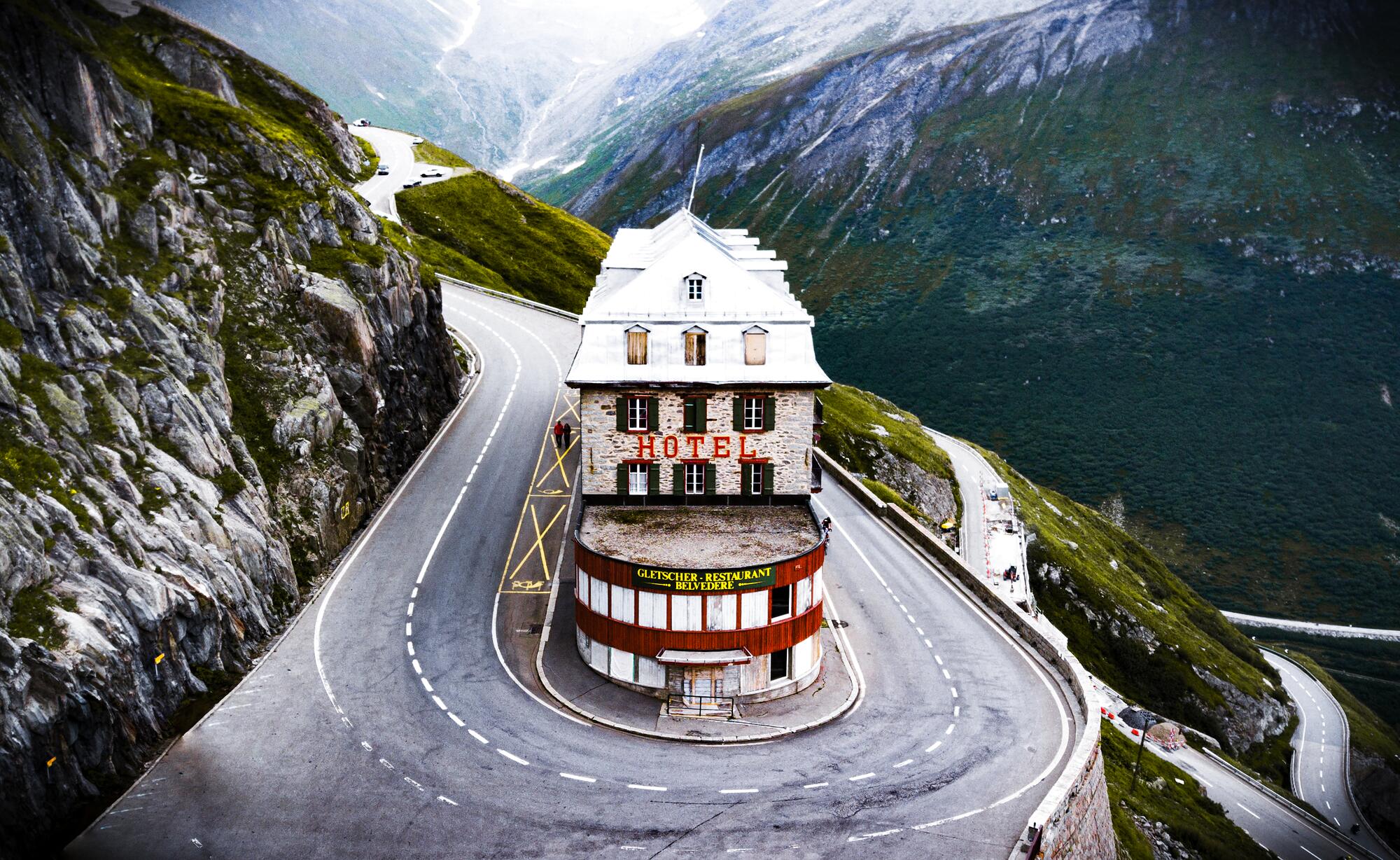
The building everyone photographs stands on the outside of a hairpin on the Valais side, a little below the summit. Josef Seiler built a lodge here in 1882 and enlarged it into a hotel in 1890, and for most of a century travellers came up to look at the Rhône Glacier, whose ice then lay almost under its windows.
The Belvédère is closed, and has been since 2015, when the family who had run it for a quarter of a century gave it up. It had shut once before, in 1980, and was rescued and reopened in 1990; this time no rescue has followed. The building has been offered for sale and stands empty, its shutters drawn. Do not plan coffee or a bed there.
The glacier has gone a long way too. It has retreated so far up the valley that the view the hotel was built for has largely gone, and every summer the ice around the grotto is wrapped in white fleece to slow the melt. The ice grotto, cut into the glacier every year since 1870 and recut each season because the ice keeps moving, is a short walk from the bend and is usually open from June. Park only where parking is marked, and never on the hairpin itself: this is a working road, and the coaches need all of it.
Goldfinger, 1964
The Furka owes much of its fame abroad to one film. In Goldfinger, released in 1964, Bond's Aston Martin DB5 tails Goldfinger's Rolls-Royce across Switzerland, and the Furka and the country around Andermatt are where it was filmed. It is here that Bond crosses paths with Tilly Masterson's white Mustang, and on the straight in the valley between Realp and Zumdorf that the DB5's tyre cutter puts the Mustang into the ditch. The hotel is in the film too.
A bend on the pass is signed James Bond Strasse, with a small lay-by and a lookout. It is a pleasant place to pull over for a minute, and a terrible one to attempt a reconstruction.
The Grimsel, seen from the top
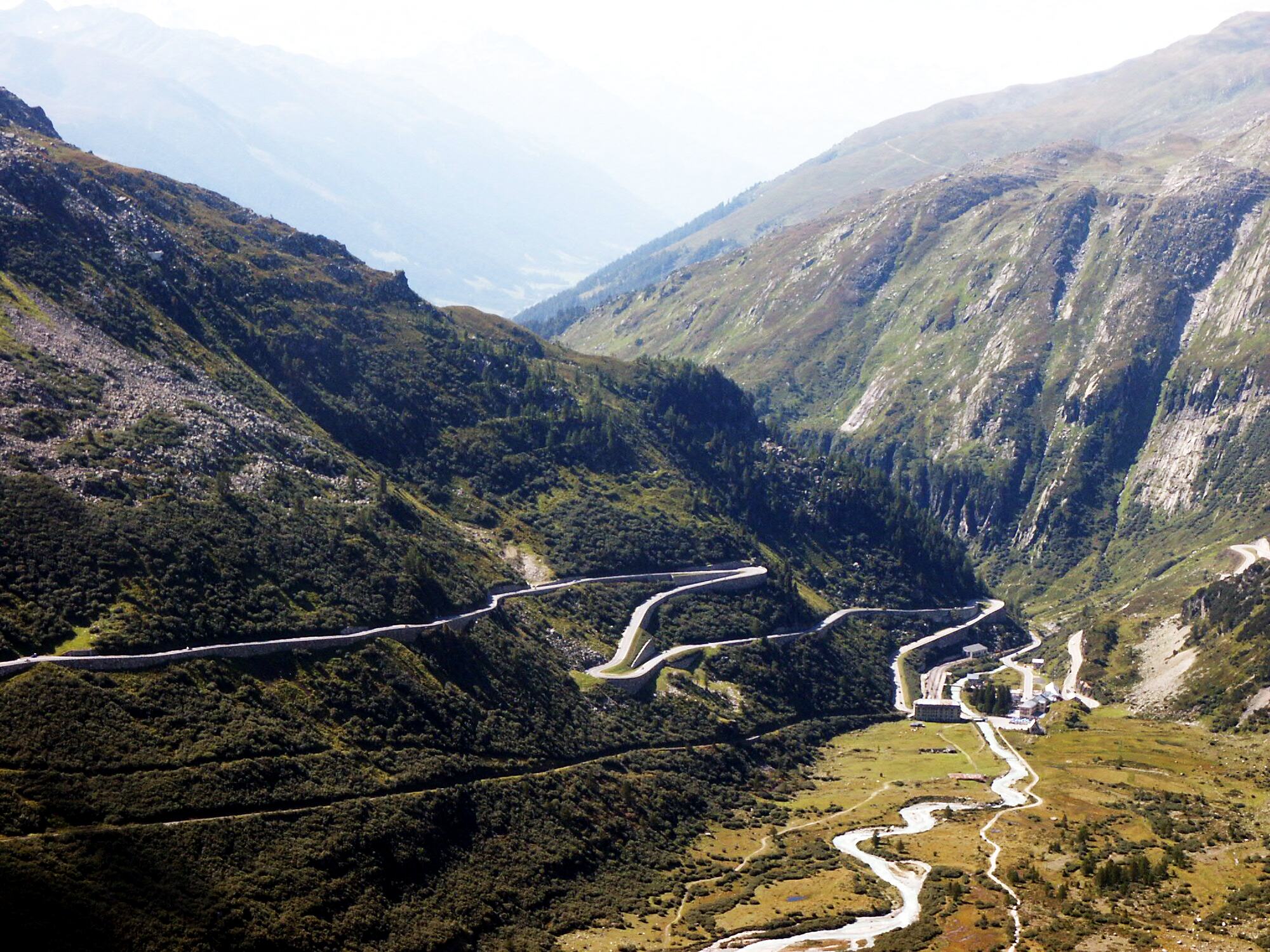
Coming down the western side you look straight across the valley at the Grimsel, its hairpins climbing out of Gletsch and stacked up the far slope to 2,164 metres. There are few places in the Alps where you can see your next pass so completely before you drive it, and from the Furka the whole line of the road is visible, bend upon bend.
Gletsch itself is barely a hamlet: a handful of buildings, the old Hotel Glacier du Rhône, a junction and a railway station. Turn right for the Grimsel and the Bernese Oberland, or carry straight on down the Goms towards Oberwald and Brig.
The Furka steam railway
The Furka has a second road, made of rails. The original line climbed to a summit tunnel at about 2,160 metres, opened in 1926, and was abandoned in 1982 when the base tunnel took the trains underneath the mountain. Volunteers refused to let it go. The Furka steam railway now runs again between Realp and Oberwald, by Gletsch, in summer only, about eighteen kilometres of mountain railway, and some of its locomotives were brought home from Vietnam in 1990 as little better than scrap and restored. The summit tunnel reached its hundredth year in 2026.
From the road you may catch its smoke in the valley below. For a passenger who would rather see the pass from a carriage window for a morning, it is the best thing on the mountain.
What to know about the car on the Furka
- Fill up in Andermatt or Oberwald. There is nowhere on the pass you will want to be looking for fuel.
- Take the western descent in a lower gear and let the engine do the work. It is long, and brakes that have been leaned on from the summit will tell you so by Gletsch.
- On Swiss mountain roads signed as postal routes the yellow PostBus has right of way. Give it the road, and the room it needs on a hairpin.
- Cyclists climb the Furka in numbers through the summer. Pass them wide, or wait until you can.
- Parts of the Uri side are narrow, with stone posts or a low wall at the edge. A wide car needs its mirrors watched; keep to your side and take those stretches gently.
Coffee, lunch and a bed
On the Uri side, a little over 2,100 metres up, the Hotel Tiefenbach serves regional food on a terrace above the valley, and is the natural place for coffee on the way up. Gletsch has the Hotel Glacier du Rhône at the foot of the descent. For a night, Andermatt lies a short drive below Realp and has the widest choice of beds, from old inns to a good deal more polished hotels, and puts the Furka, the Oberalp and the Gotthard all within a short drive of breakfast.
Driving the Furka with the club
The club's European Tour crosses the Furka on its fourth day, the great day of the week. The party leaves Ticino up the Val Blenio for the Lukmanier, crosses by Disentis to the Oberalp, and has lunch above Andermatt with the valley below. Then the Furka, Realp to Gletsch, the right way round, followed at once by the Grimsel and the long descent down the Hasli valley to Spiez on Lake Thun by the evening.
The route is driven in full, in season, before a member sees it, and if snow keeps a pass shut the roadbook carries the alternative. The pace is the road's: brisk where it invites it, gentle where it does not, and always within the law. The tour page sets out the week at https://valenzaprive.com/european-tour, and membership, which is free and begins with an application read personally by the team, is explained at https://valenzaprive.com/membership. If the Furka is the road you have been meaning to drive, we would be glad to drive it with you.
Photographs: LIU Xiao, CC BY-SA 4.0; Norbert Aepli, CC BY 2.5. Colours graded by the club.