
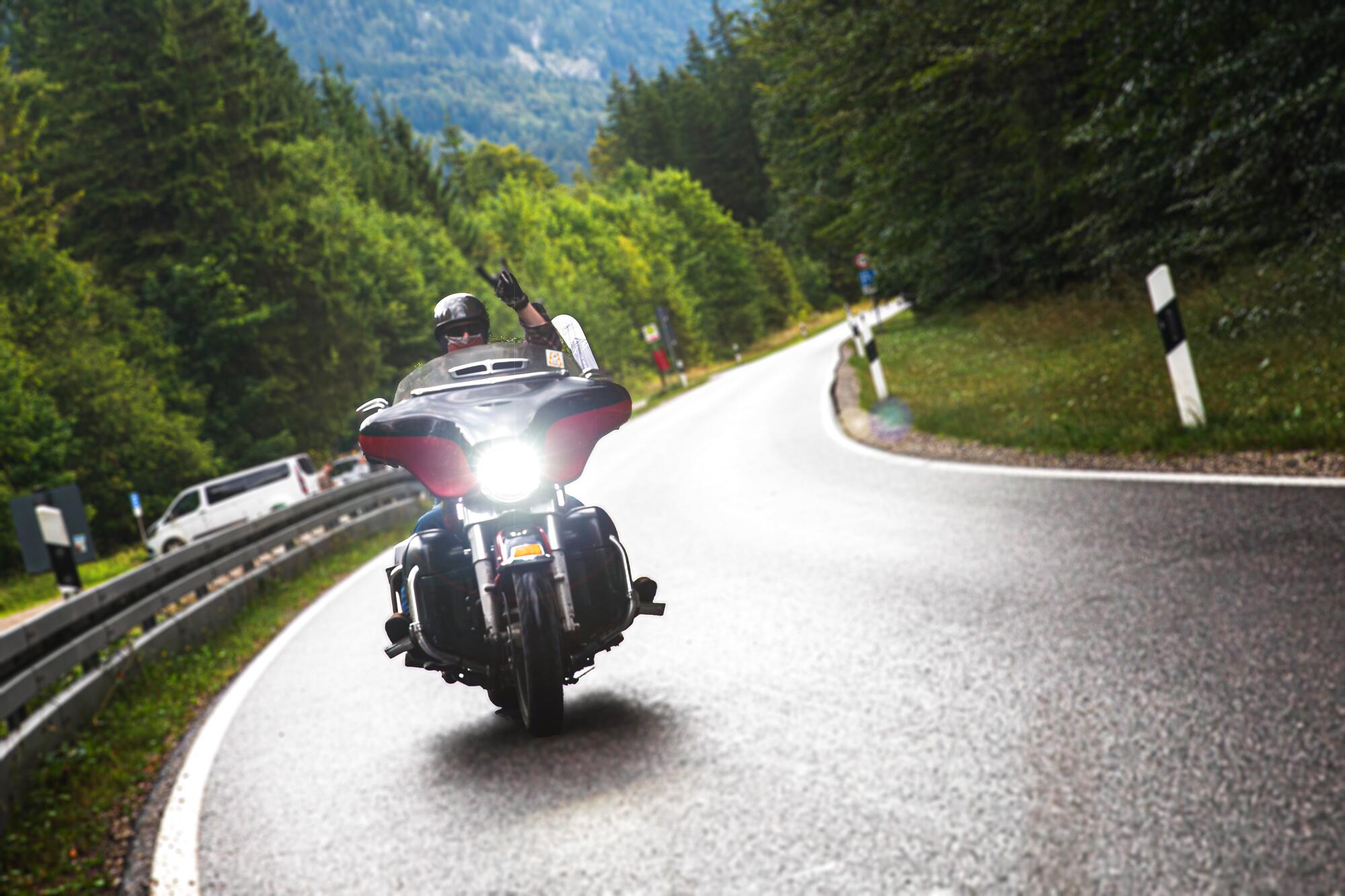
Andermatt at seven in the morning, and the saddle is wet with dew. Above the village the Furka road leaves the valley floor and climbs west in long, open loops, the cowbells carrying further than the engine. By nine you will have crossed into the Valais, watched the Rhône begin as meltwater beneath its glacier, and climbed again to the Grimsel, where a dozen bikes stand in a row by a small dark lake and their riders stamp their boots for warmth. A Swiss Alps motorcycle tour has no better first morning than this.
The four great passes of the central Alps, the Furka, the Grimsel, the Susten and the Nufenen, sit so close together that a rider can take in three before lunch and the fourth before dinner. None is the hardest road in Europe, and none needs to be. They are wide, well kept and endlessly varied, and on a bike you feel every change in the air between the valley and the top.
The classic loop of the motorcycle Swiss passes
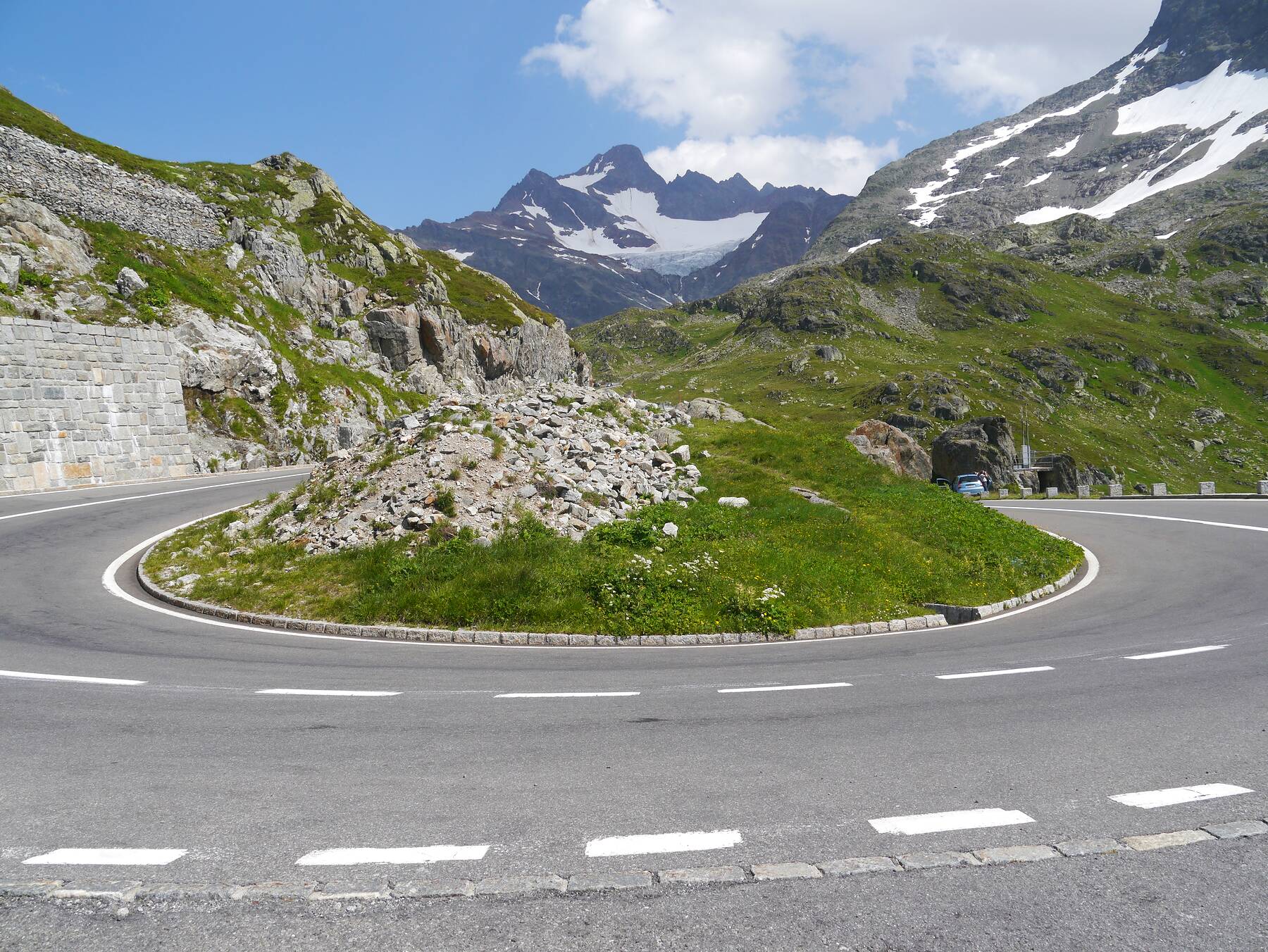
The loop most riders begin with starts at Andermatt and takes in three passes in a single circuit. The Furka climbs west by Realp to 2,429 metres, then drops in a staircase of hairpins past the Rhône Glacier to Gletsch. This is the road where Bond's Aston Martin chased a Ford Mustang in Goldfinger, filmed on the pass in the summer of 1964. Halfway down sits the old Hotel Belvédère on its hairpin, the most photographed building on the road. It has been closed for a decade, so admire it from the saddle and ride on.
From Gletsch the Grimsel climbs north to 2,164 metres, past the Totensee at the top and the great dams and reservoirs below it, then runs down the Hasli valley to Innertkirchen. There the Susten turns east, climbing beneath the Stein glacier to 2,224 metres and a short tunnel at the summit, before the long descent through the Meiental to Wassen and the Schöllenen gorge back to Andermatt. The Susten was built between 1938 and 1946, one of the first Swiss passes designed from the start for motor traffic, and it shows: broad, steady, beautifully engineered.
The Nufenen makes the fourth. It leaves the Goms valley at Ulrichen and climbs to 2,478 metres, one of the highest roads in Switzerland, then descends into Ticino and the Italian speaking south at Airolo. Ride back north over the Gotthard and you can take the Tremola, the old road, which climbs from Airolo in twenty four cobbled hairpins and is one of the great pieces of road building in the Alps.
When to go on a Swiss Alps motorcycle tour
The high passes close for winter and reopen only when the snow has been cleared, usually between the middle of May and the middle of June. In 2026 the Furka, the Grimsel and the Nufenen reopened together at the end of May, with the Susten a little later. They close again with the first heavy snow, any time from October onwards.
The best of it is from late June to September. July and August bring the most traffic, and fine weekends fill the tops with bikes, cars and cyclists in equal measure. A weekday in early September, with the light low and the roads quiet, is hard to beat. Check each pass's status the evening before you ride: an early snowfall or a rockfall can close one for a day.
Cold at altitude, and what to wear
The air cools by roughly six degrees for every thousand metres you climb. A warm morning in the valley at Andermatt can be close to freezing on the Nufenen, often with snow banks beside the road into July, and by lunch on the Ticino side you will be glad to open every vent you have.
Dress in layers you can change at the roadside: a thermal base, a mid layer, a jacket with a waterproof lining, and proper winter gloves in the tank bag beside the summer pair. Heated grips earn their keep here. Storms build quickly over the high ground on summer afternoons, so ride the highest passes in the morning when you can.
Tunnels, cobbles and the road surface
The roads are well surfaced, but the mountains keep a few surprises. Tunnels and avalanche galleries come suddenly, and going from high sunshine into an unlit tunnel with a dark visor is a moment of near blindness. A clear visor with good sunglasses, or a helmet with a drop down sun shade, solves it. The Susten's summit tunnel is short; others on the passes are longer.
The Tremola's cobbles are a pleasure dry and treacherous wet, and worth riding gently either way. Elsewhere, watch for meltwater running across the road in early summer, grit in the hairpins, cattle on the unfenced stretches of the Furka, and cyclists on every climb. The yellow postbus has priority on the mountain roads, and its three note horn announces it round the blind bends. Give it room.
Fuel
There are no pumps at the tops. Fill up in the valley towns, such as Andermatt and Airolo, before each climb, and fill the evening before a big day, because pumps in the mountain villages are few, many close early, and some take only cards. A bike with a small tank should not leave a valley less than half full.
Where bikers stop
The Grimsel is the great gathering place. At the top, beside the Totensee, the Hotel Grimsel Passhöhe and the Alpenlodge Grimselpass, with its Plänggerli restaurant, serve riders through the summer, and the car park is a free exhibition of everything with two wheels. A little below, on the Bernese side, the Grimsel Hospiz stands on its rock above the reservoir, a historic mountain hotel with a restaurant and a self service counter through the season.
On the Susten, the Berghotel Steingletscher sits below the summit on the Bernese side, beneath the glacier it is named for, open from June to October and long a meeting place for motorcyclists. The Nufenen has a restaurant at the pass with a large self service room and a menu of Valais and Ticino dishes.
On the Furka, with the Belvédère closed, plan to take your coffee on the Grimsel instead.
Swiss rules for motorcycles
- Motorcycles need the motorway vignette too, and a car's vignette does not cover a bike. It costs CHF 40, as a sticker or as an e-vignette linked to the number plate, bought from the Swiss government's own webshop, and is valid from 1 December of the year before the one printed on it until 31 January of the year after.
- Lights must be on whenever you ride, day and night.
- Helmets are compulsory for rider and passenger, and must meet the ECE standard.
- Filtering to the front of a queue is not allowed. Take your place in the line.
- The limits are set in law: 120 kilometres an hour on motorways, 100 on expressways, 80 on other roads outside towns and 50 in them, unless signed otherwise. Switzerland treats serious speeding as a crime.
- Radar detectors are illegal, even carried and unused.
- The drink drive limit is 0.5 grams per litre.
Riding out, or sending the bike ahead
Most riders from Britain ride out, and the ride is part of the pleasure. Le Shuttle carries motorcycles from Folkestone to Calais in thirty five minutes, and from there it is about 650 kilometres to Basel, through Reims and the Franche-Comté or through Alsace, and about two hours more to Andermatt. Two days each way leaves the riding fresh. Carry your licence, the V5C, passports issued within the last ten years, and insurance that covers France and Switzerland. A green card is no longer needed, but the bike must show a UK identifier, on the plate or as a sticker.
Riders with less time often send the bike ahead on a transporter and fly to Zurich, collecting it within a couple of hours of the passes. It costs more, and it gives back four days.
Riding with the club
Valenza Privé's members drive and ride. The club's European Tour, in June, takes in these same roads, the Furka, the Grimsel, the Susten and the Nufenen among them, from bases at Ascona on Lake Maggiore and Spiez on Lake Thun. The tour is set out at https://valenzaprive.com/european-tour, and members hear first when places on any tour open.
If the passes are where you would rather be on two wheels, we would be glad to hear from you. Membership is free, by application, and every application is read personally by the team: tell us what you ride when you apply, at https://valenzaprive.com/membership.
Photographs: the U.S. Army Reserve, public domain; Zairon, CC BY-SA 4.0. Colours graded by the club.