
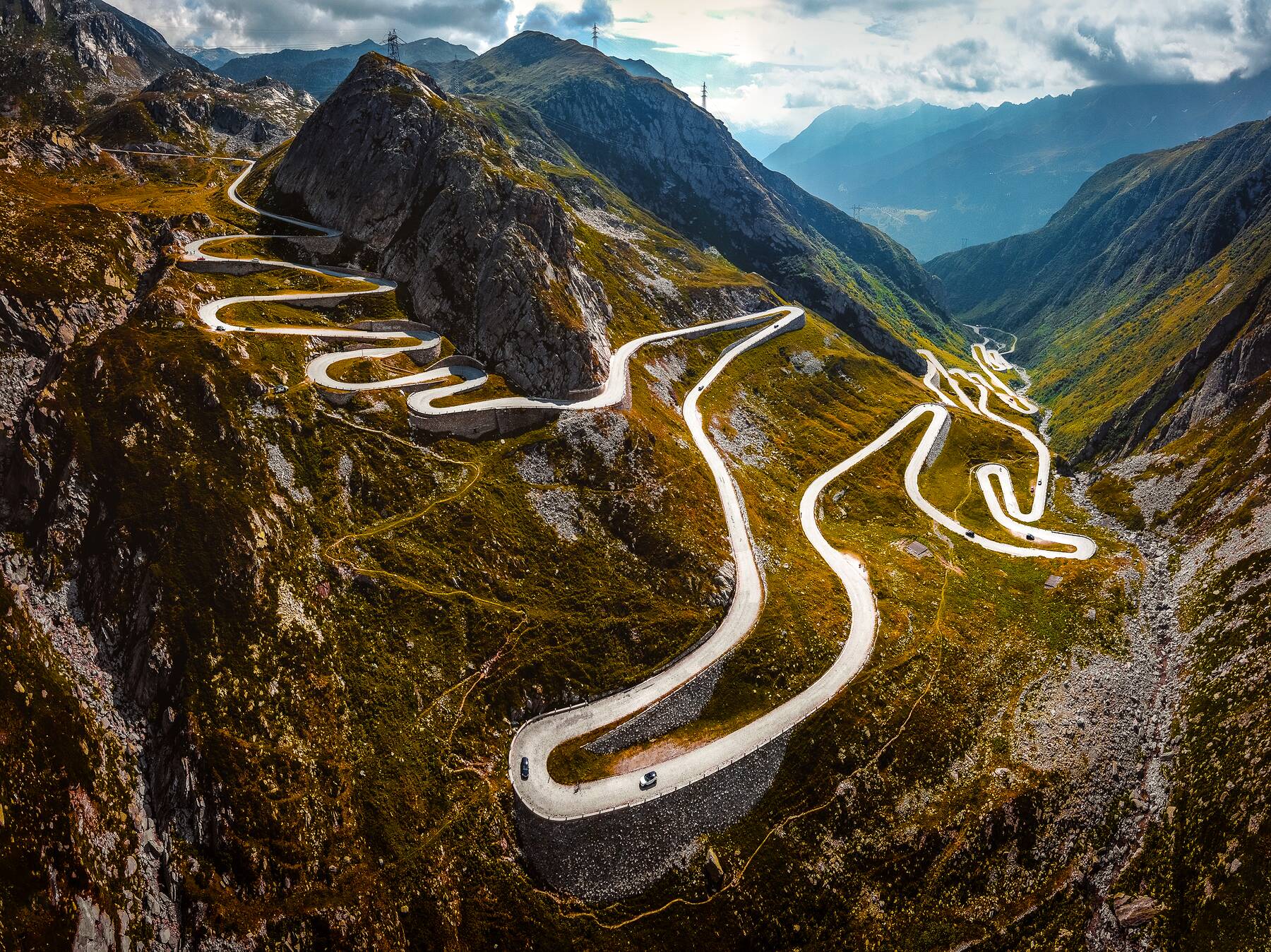
Seen from the top, the Tremola looks less like a road than a piece of needlework. Stand by the wall below the hospice at the top of the Gotthard Pass and look down the Val Tremola, and the old road folds back and forth across the valley floor in loop after loop of grey stone, each bend shored up by a wall of dressed granite, until it disappears towards Airolo far below. Then you hear it before you see it: the low, even drumming of tyres on setts, as a car comes up out of the valley one hairpin at a time.
The Tremola is the old southern approach to the Gotthard Pass, and it is listed in the Swiss inventory of historic roads as the longest road monument in the country. Most traffic has long since moved to the newer road and its galleries across the valley. The old one is left to those who want it, and on a quiet morning it can feel as though it was laid for you alone.
Where the Tremola is
The Tremola climbs from Airolo, at 1,175 metres in the upper Leventina, to the top of the Gotthard Pass at 2,106 metres, in the canton of Ticino a couple of kilometres short of the border with Uri. Its finest stretch is about four kilometres long and gains some three hundred metres through twenty-four hairpins, every one of which has its own name. The road is six to seven metres wide, held up in places by walls eight metres high, with its dry-stone walls, granite paving and stone markers largely as they were.
Leave the main road above Airolo where the old road is signed, and the tarmac soon gives way to stone. There is a weight limit of 3.5 tonnes, which keeps coaches and lorries off it, and that alone changes the character of the drive.
A road older than its cobbles
The road itself is older than most people think, and its cobbles younger. The carriage road between Göschenen and Airolo was built between 1827 and 1832 to the design of the Ticino engineer Francesco Meschini, part of a long programme to open the Gotthard to wheeled traffic. For more than a century before the setts it carried the Gotthard post coach, the one Rudolf Koller painted coming down the Tremola behind its team of horses.
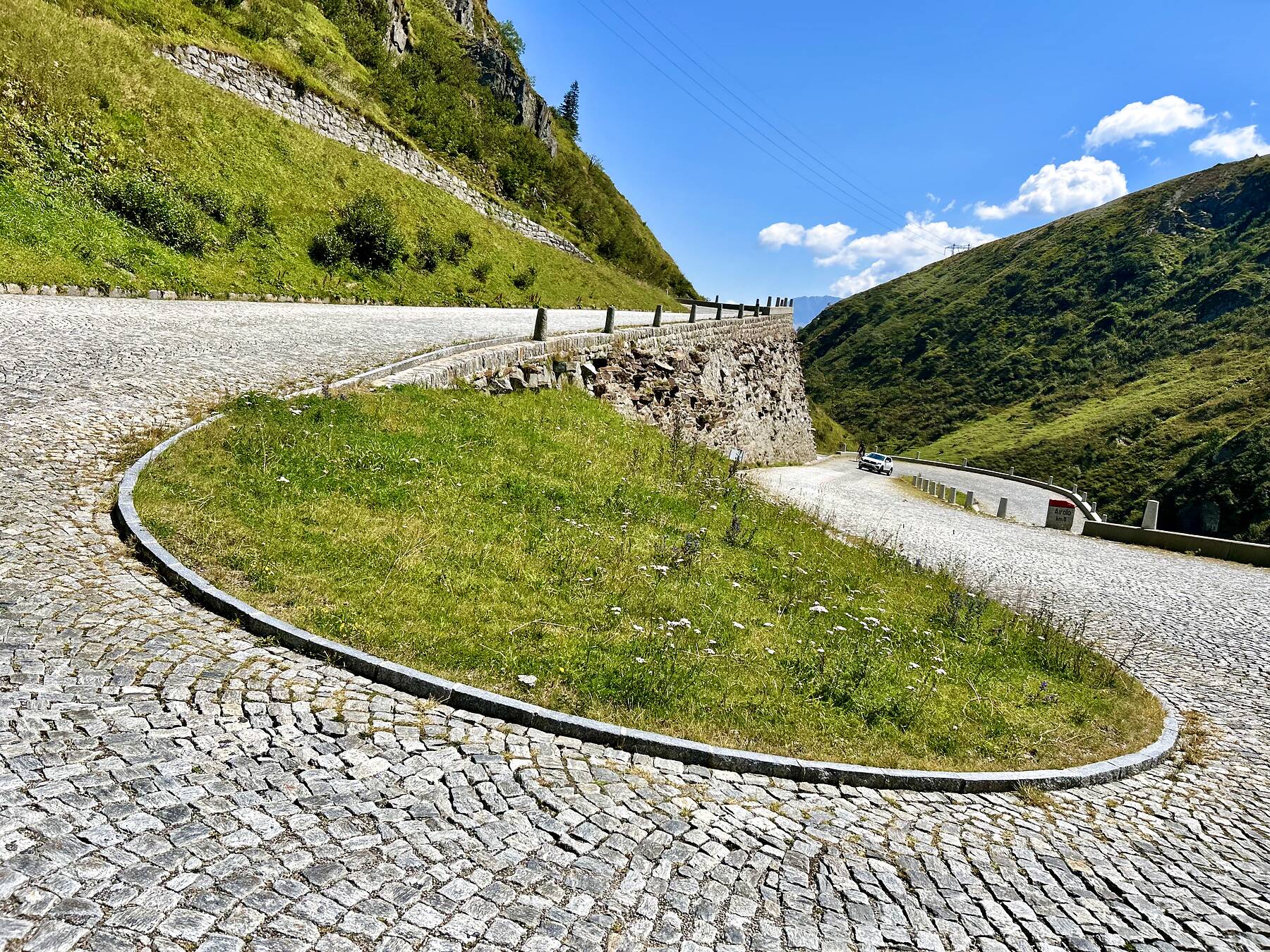
The setts came later. Hundreds of thousands of granite cobbles were laid between 1937 and 1941, and the road you drive today is essentially the one finished in 1951. The trains had gone underneath the mountain in 1882; the motorway tunnel followed in 1980. The Tremola survives because, almost by accident, it was left alone.
Which way to drive the Tremola
Uphill. The Tremola is open in both directions, but it is best driven as the coach horses saw it, climbing from Airolo. Going up you meet each hairpin with the car settled and the engine pulling, the view opens behind you at every turn, and you arrive at the hospice with the whole valley spread below. Coming down, on stone, you are on the brakes into every bend and looking at your feet rather than the mountains.
If you are crossing north, the Tremola is simply the more interesting way up. If you are heading south, drive the newer road down to Airolo and come back up the old one. It adds well under an hour, and nobody has yet regretted it.
Opening months on the Gotthard Pass
The Gotthard closes for the winter and the Tremola with it. In recent years the pass has opened in the second half of May, between 16 and 29 May from 2022 to 2026, and closed in early or mid November. The dates move with the snow, so check the cantonal road status the evening before, and if the pass is shut the road tunnel will carry you under it.
Early mornings are best. By the middle of a summer's day the Tremola draws cyclists, walkers and photographers, and the hospice car parks fill.
Driving cobbles in a low car
The setts are the whole point, and they ask something of the car. A few things are worth knowing.
- The surface drums. In a car on stiff suspension and low profile tyres it is loud and busy, and on a firm setting it is tiring. If the car offers a softer mode for the dampers, this is the road for it.
- Dry granite grips well. Wet granite, especially in the shaded bends where moss creeps between the stones, does not. In the wet, brake in a straight line before each hairpin and leave the throttle alone until the car is pointing out of it.
- The road is wide for an old pass, and the hairpins are generous for their age, so a long car turns without fuss. The walls, though, are close and made of granite. Take the tight inside of each bend at a walking pace and watch the nearside wheel.
- Ground clearance is rarely an issue on the cobbles themselves. Take care where you pull off for a photograph: the verges are rough and the drainage channels deep.
- Pick a gear and stay in it. A car that is shuffling between first and second on every hairpin is working harder than it needs to.
- Cyclists climb the Tremola for the same reason you do. Give them the room you would want, and wait behind them on the bends.
The hospice and the museum at the top
The top of the Gotthard is a small plateau of lakes and buildings at 2,106 metres. Beside the Lago della Piazza stands the old hospice, the Ospizio San Gottardo, run since 2010 as a small hotel of thirteen rooms alongside the Albergo San Gottardo next door. For a driver who wants the Tremola at first light, a night up here is the answer.
Next to it, in a building of 1834 that served stagecoach travellers as a customs house and hotel, is the National Gotthard Museum, reopened in 2022 after two years of renovation and open in the summer months. It tells the story of the pass from mule track to motorway, and it is the right place for half an hour while the engine cools.
Coffee, lunch and where to stay
There are restaurants by the lake at the top for coffee or a plain lunch with a view. Airolo, at the foot of the Tremola, has bakeries and cafés for an early start, and fuel. On the north side the road runs down through Hospental to Andermatt, which has the widest choice of beds in the region and a good deal of very good cooking, and puts the Gotthard, the Furka and the Oberalp all within a short drive of breakfast.
The Gotthard with the club
The club's European Tour crosses the Gotthard from Airolo on its fifth day, on a day that takes in four of the great Swiss passes. The party leaves Spiez over the Grimsel, crosses the Nufenen at 2,478 metres and comes down the Val Bedretto to Airolo, then climbs over the Gotthard and down to Andermatt, before the Susten carries everyone home into the Oberland. The Tremola begins in the same town where the Nufenen ends, and on a dry morning the old road is worth the detour.
The route is driven in full, in season, before a member sees it, and the pace is the road's: brisk where it invites it, gentle where it does not, and always within the law. The week is set out at https://valenzaprive.com/european-tour, and membership, which is free and begins with an application read personally by the team, is explained at https://valenzaprive.com/membership. If twenty-four hairpins of granite are calling, we would be glad to hear from you.
Photographs: Patryk Hejduk, CC BY-SA 4.0; Olgierd Rudak, CC BY-SA 4.0. Colours graded by the club.