
The shuttle leaves Folkestone in the half light, and thirty five minutes later you drive off it into France with the sun coming up over the Pas de Calais. By the time the coffee has gone cold the A26 has you alone among the beet fields, the road straight and wide, the lorries all bound for somewhere else. Driving to Switzerland from the UK begins like this, with a long, quiet morning across the north of France, and it ends two days later with the first snow on the skyline beyond Basel.
It is a drive worth doing properly. Done in a single push it is a chore. Done in two days, with a good dinner in the middle, it is the overture to everything the Alps have waiting.
The crossing
Le Shuttle, from Folkestone to Calais, is the quickest way over. The crossing takes thirty five minutes, you stay with the car, and the loading is level, which matters in anything low. The ferry from Dover takes about an hour and a half and gives you a proper breakfast and a walk on deck. If your car sits close to the ground, tell the ferry operator when you book: some ramps are steep, and the crew can put you in a lane that suits it.
Allow more time than you once did for the first crossing. The French border checks happen in England, at Folkestone and at Dover, and British travellers are now registered at the Schengen border with fingerprints and a photograph on their first visit.
Driving to Switzerland from the UK: the route through France
From Calais the A26 runs south past Saint-Omer and Arras to Reims, about 266 kilometres and a little under three hours. At Reims there are two good ways on.
The first keeps south on the A26 to Troyes, then takes the A5 to Langres, a walled town on its hill, and turns east through the Franche-Comté by Vesoul and Belfort, or by Besançon on the A36, to Mulhouse and Basel. It is open, rolling country with very little traffic, and the more direct of the two.
The second turns east from Reims on the A4, past Verdun and Metz towards Strasbourg, then runs south down the Rhine plain beneath the Vosges, past Colmar and its vineyards, to Mulhouse and Basel. It is a little longer, and it passes through Alsace, which is reason enough.
Either way, Calais to Basel is about 650 kilometres, and around seven hours at the wheel before you stop for anything. Interlaken, Andermatt or the Italian lakes are hours further on. That is why the sensible answer is two days.
Where to break the journey
Reims is the obvious first night if you cross in the afternoon. Domaine Les Crayères is a château in a seven hectare park on the edge of the city, a member of Relais & Châteaux since 1984 and long one of the great tables of Champagne. The cellars of the great champagne houses are its neighbours.
On the Alsace road, the Villa René Lalique stands at Wingen-sur-Moder in the northern Vosges, a short detour from the A4. Lalique built it in 1920, in the village where he opened his glassworks the following year. It is now a hotel of six suites with a restaurant in a glass pavilion by the Swiss architect Mario Botta, two Michelin stars and a cellar of some sixty thousand bottles. Book early, because six suites go quickly.
Papers, in brief
The full list is in our guide to taking your car to Europe, at https://valenzaprive.com/journal/taking-your-car-to-europe. The short version: your photocard licence, the original V5C, and passports issued within the last ten years and valid for at least three months after you leave.
A green card has not been needed for Switzerland or the European Union since August 2021, but your policy may give only the legal minimum abroad unless you ask for more, so confirm in writing that the car is fully covered in France and Switzerland. The car must carry the UK identifier: a number plate showing UK with the Union flag is enough, and otherwise a UK sticker goes on the back. The old GB sticker is no longer valid.
The Swiss motorway vignette
Every car on a Swiss motorway needs a vignette, and you will meet the motorway within minutes of Basel. It costs CHF 40 and comes as a sticker for the windscreen or as an e-vignette, linked to your number plate rather than to the car, and bought online before you leave. Buy it from the Swiss government's own webshop, where the price is the price; other sites charge more for the same thing.
Each vignette is valid for fourteen months, from 1 December of the year before the one printed on it until 31 January of the year after. A 2027 vignette therefore covers December 2026 to the end of January 2028. A trailer needs one of its own, and so does a motorcycle.
The Crit'Air sticker
France's low emission zones survived an attempt to abolish them in 2026, when the Constitutional Council struck the repeal down, and they apply to British cars as much as French ones. The motorway route need not take you into any of them, but if you mean to stop in Strasbourg, Lyon or Paris, order a Crit'Air sticker from the French government's own site before you go. It costs a few euros; allow a couple of weeks for the post.
Swiss rules worth knowing
- Headlights or daytime running lights must be on whenever you drive, day and night, in any weather.
- The limits are set in law: 120 kilometres an hour on motorways, 100 on expressways, 80 on other roads outside towns and 50 in them, unless the signs say otherwise. Signs often appear only once.
- Switzerland treats serious speeding as a crime, with the licence and even the car at stake.
- Radar detectors are illegal, whether used or simply carried, and may be confiscated. Leave yours at home.
- The drink drive limit is 0.5 grams per litre, lower than in England.
The car on the passes
The road to Switzerland is easy on a car. The passes are not, and a little preparation pays for itself.
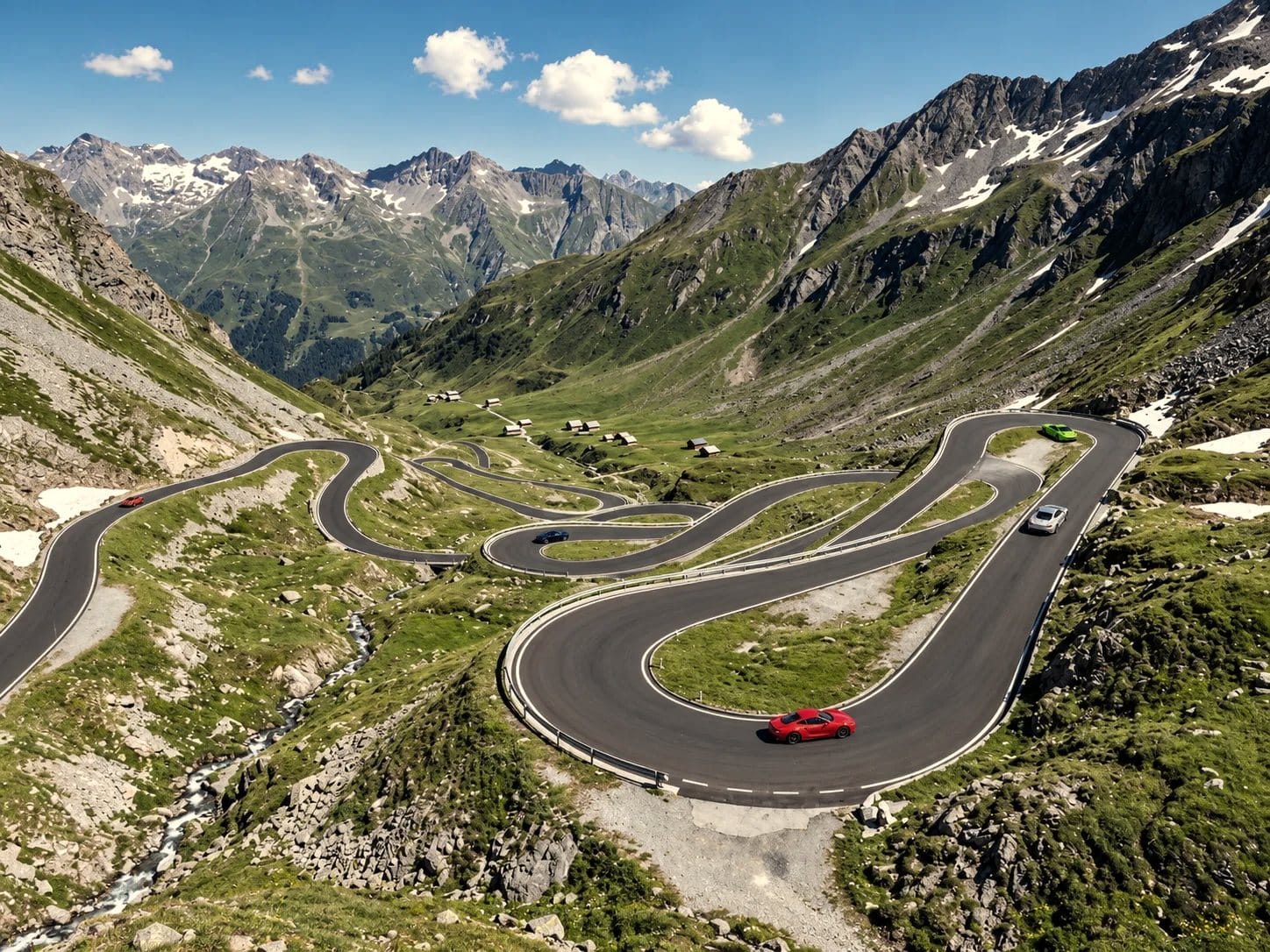
Brakes come first. A long descent from 2,000 metres asks more of them than a year of British motoring, so have the fluid changed if it is old, and come down in a lower gear, letting the engine hold the car and using the pedal in firm, short applications rather than a constant drag. Carbon ceramic brakes cope well, but they still want the engine's help.
Tyres matter more than usual. Summer tyres are right from June to September, but they need a little warmth to grip, and at seven in the morning near the top of a pass the air may be close to freezing. Check the pressures cold, in the valley, and give the first few bends a gentle hand.
Altitude takes something from an engine. A naturally aspirated car feels it noticeably at the top of a pass, a turbocharged one much less, and none of it does any harm. The practical concern is fuel. Pumps on the mountain roads are few, many close early, and some take only cards. Fill up in the valley the evening before, with 98 octane, sold as Bleifrei 98 in Switzerland.
On the narrower mountain roads, the yellow postbus has priority, and its three note horn announces it round the blind bends. Pull in and let it by. The drivers know every metre of the road, and the passengers are usually waving.
Driving on with the club
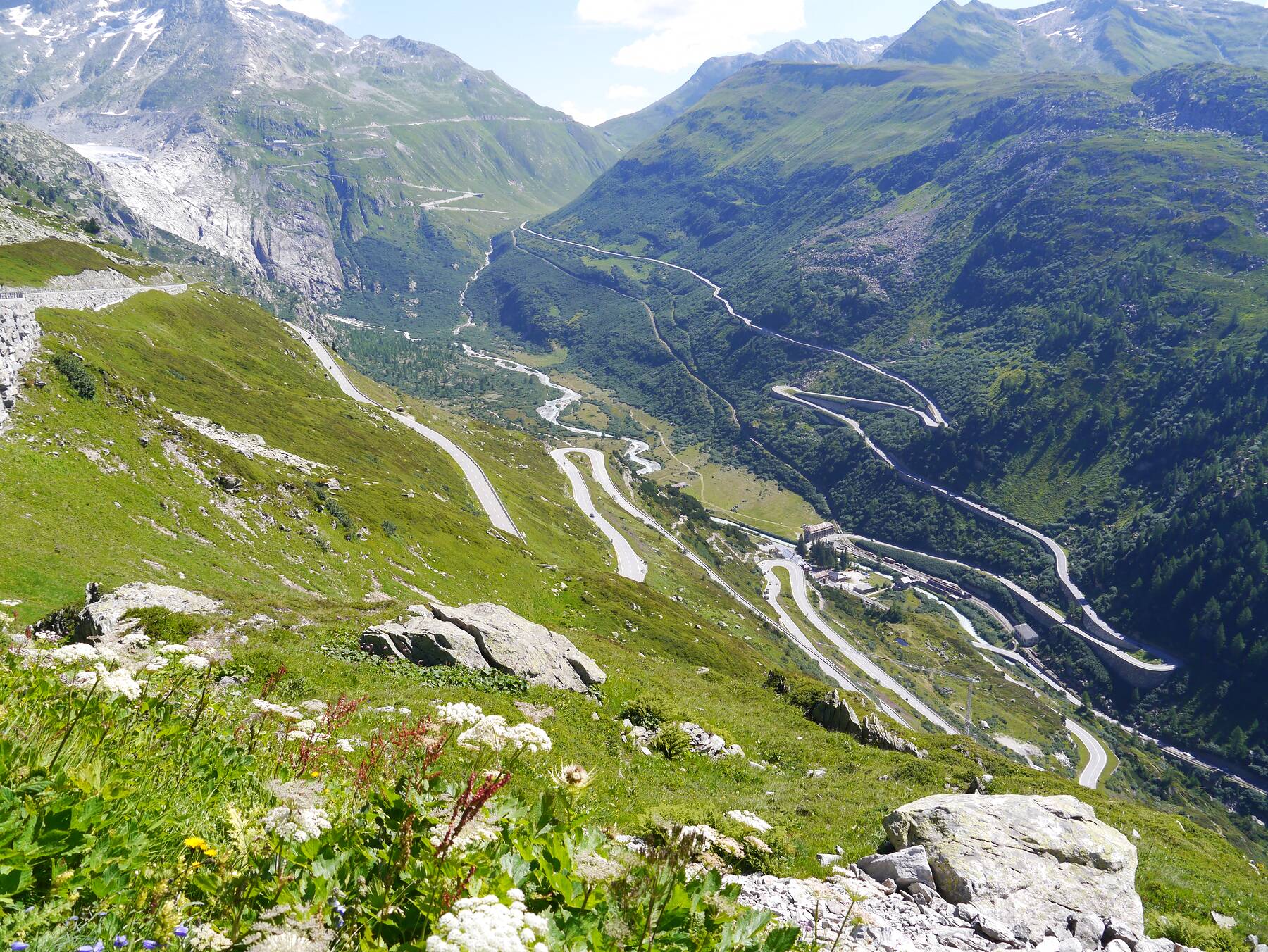
The club asks its members to settle all of this before the European Tour, and the tour is the best reason we know to make the drive. It is a week built around two places: three nights at Ascona on Lake Maggiore, three at Spiez on Lake Thun beneath the Bernese Oberland, and five days at the wheel between them over eleven passes, from the Simplon and the Nufenen to the Furka, the Grimsel and the Susten. It runs in June, when the high roads are open and the lakes are warm.
Ascona is two comfortable days from Calais, and the club suggests a route and a hotel for the night on the way once the dates are confirmed. The roadbook carries every turn, every pump and every border. The tour is set out in full at https://valenzaprive.com/european-tour, and members hear first when its places open. Membership is free, by application, and every application is read personally by the team.
Photographs: Zairon, CC BY-SA 4.0. Colours graded by the club.